

WP5. Methods and theoretical framework development
Work Package 5 brought together findings across the project through a series of online consensus workshops across project partners.
The workshops set out to establish priority research and economic evaluation frameworks for Technology Enabled Care Services. The discussions focused primarily on technology costs, trust, digital inclusion and exclusion, and the challenges of integrating services across LAs, NHS trusts, and ICBs.
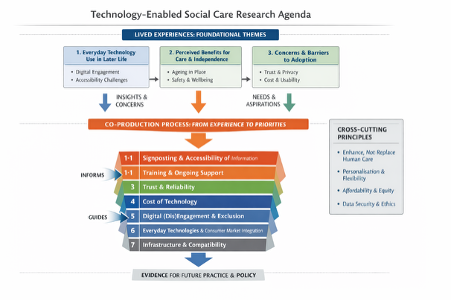
A research agenda for technology enabled social care (Marston et al., 2026)
The workshops highlighted a number of critical gaps and system level tensions that continue to hinder the effective scaling of TECS. Frontline staff and clients face ongoing skill and knowledge gaps regarding available devices and training in device and wider service support. Decision-makers continue to highlight a sparse evidence base dominated by small-scale pilots as a challenge to knowing what technology to deploy, and how to deploy them.
Challenges continue in balancing resources and service needs between social care commissioners and health care providers. Social care teams must balance immediate financial limits and affordability, particularly if the benefits are primarily experienced in health care, against broader goals of user independence and quality of life. To resolve these barriers, there is an urgent need for standardized, local evaluation tools that allow social care providers to track impact, compare performance across regions, and establish economic models that can capture both client preferences and benefits experienced across the social care system.
Both LA staff and health economists emphasized that traditional, trial-based evaluation methods are insufficient for capturing the complex, social reality of care technology, calling instead for more flexible, dynamic and locally focused research methods, which allow for the evaluation of highly localised, complex interventions. Examples of such approaches include Discrete Choice Experiments, realist evaluations, quasi-experimental designs using routine digital data and the use of implementation science frameworks such as the Non-Adoption, Abandonment, Scale up, Spread and Sustainability (NASSS) framework.